
The Prime Directive of Dance Writing: A Star Trek Model for the Dance Ecosystem
By Rachel Benzing
Rachel Benzing is a dancer, choreographer, educator, and writer based in the Chicago area, whose work explores tap dance, interdisciplinary performance, and the intersections of dance, culture, and identity. She holds an MFA in Dance: Creative Practice from Trinity Laban Conservatoire of Music & Dance and teaches dance at College of DuPage, while contributing dance criticism and scholarship to See Chicago Dance and other publications.
Instagram @rachel_benzing_

As a lifelong self-identifying nerd who grew up watching Doctor Who, reading Ray Bradbury, and staring through my family’s telescope out into the night sky, I have always been drawn to stories about exploration: encountering unfamiliar worlds, learning from different cultures, and trying to understand perspectives beyond our own. Since participating in the MoBBallet Writers’ Workshop: Examining the Role, Responsibilities, and Relevance in the Evolving Ecosystem of Field hosted by The National Center for Choreography – Akron (NCCAkron) July 13–17, 2026, I have found myself thinking about dance writing through that same lens.
The workshop asked us to interrogate the dance ecosystem and where we, as dance writers, are positioned within it. We questioned the historical hierarchies that have determined which artists, forms, institutions, and voices receive attention. We examined how our social identities impact our writing and how those identities shape what we notice, value, and overlook.
Acknowledging one’s personal lens complicates the idea of the dance writer as an objective observer. The dancing body is not neutral, and neither is the person writing about it. Every writer arrives with a particular history, cultural knowledge, experience, and set of assumptions. The responsibility, then, may not be to eliminate those lenses, but to become conscious of them.
Rather than beginning with whether a work was “good” or “bad,” or if we personally “liked” it, can we ask more productive questions? What was the artist attempting to do? Did the work communicate that intention? What histories, conditions, or aesthetics inform the artist’s choices? And what might our own response reveal about ourselves?
The dance writer becomes an interlocutor: someone participating in a dialogue rather than delivering a final pronouncement. Writing can create a conversation; approaching a work with genuine curiosity invites readers to look more closely, ask their own questions, and consider new perspectives—providing them with tools and inviting them to investigate their own ideas.
Dr. Alice Sheppard’s session, “Conversations: Dance Writing and Disability,” discussed what it means to encounter dance by disabled artists as an audience member or outsider, particularly when one lacks familiarity with the culture and history from which a work emerges. Sheppard observed that, without that cultural familiarity, “audiences, reviewers, and critics are also still likely to judge our work by their assessment of what they can do in their bodies and what we should be able to do,” based on their understanding of disability and diagnosis. She informed us that most dance writers are unaware that they do not even possess the vocabulary or the language necessary to discuss the work.
Ironically, dance writers provide the language, context, and points of entry through which audiences may encounter work they do not yet understand. But that role carries responsibility.
I left the workshop thinking less about the dance writer as an authority and more about the dance writer as a participant—someone who enters an ecosystem that is already full of its own histories, relationships, languages, traditions, and ways of knowing. We arrive with our own perspective, but we are entering a world that existed before we arrived and will continue after we leave. Our responsibility is to pay attention to where we are, understand as much as we can about the world we have entered, and remain aware of the limitations of the lens through which we see it.
That realization brought me back to the stories of exploration that first captured my imagination as a child. The explorers I have always found most compelling are not the ones who arrive in an unfamiliar world already convinced they understand it. They observe, listen, and ask questions. They encounter something strange or unfamiliar and resist the impulse to immediately measure it against the standards of the world they came from.
So what if the dance writer is an intergalactic explorer?
The comparison may sound ridiculous at first, but the more I think about it, the more useful it becomes. A dance writer enters an ecosystem that already exists. Artists have histories, communities have relationships, traditions have developed over generations, and audiences bring their own knowledge and experiences. We arrive, observe, investigate, interpret, and eventually leave behind our own account of what we encountered.
Thinking about the dance writer this way also makes the power of the role more visible. An explorer is never simply a passive observer. The act of entering another world changes the encounter, and the account that explorer brings home shapes how others understand what they have not experienced themselves. In the same way, a dance writer’s presence, perspective, and words become part of the ecosystem they are documenting.
And this is where Star Trek’s Prime Directive becomes an especially compelling framework for thinking about the responsibilities of dance writing.
The Prime Directive is Starfleet’s guiding principle of non-interference. Its purpose is to prevent Starfleet officers from imposing their own values, technologies, or worldview on civilizations they encounter. It does not mean that Starfleet cannot observe, ask questions, learn, or form relationships. Rather, it asks its officers to recognize that entering another world carries power and that their presence can have consequences.
The dance writer faces a similar tension.
We are not neutral observers. We bring our own histories, identities, education, aesthetics, relationships, assumptions, and expectations into every performance we attend and every piece we write. We cannot completely remove ourselves from the work. But we can become more conscious of the perspective from which we are observing and more thoughtful about how we interpret what we encounter.
The Prime Directive, then, offers less of a set of rules than a question: How do we enter someone else’s world without assuming that world belongs to us?
For me, that question has led to four recurring roles within dance writing: the connector, the researcher, the witness, and the archivist. Each reflects a different kind of Starfleet mission, and each carries its own responsibilities.
The Connector
Like a Starfleet crew making first contact with a new civilization, the connector creates points of entry between artists and audiences.
A review, interview, preview, or artist profile may be someone’s first encounter with a choreographer, company, or dance form. For audiences outside the relatively insular dance world, writing can provide context and an invitation: Here is something happening. Here is a way into it. Come take a look.
One of the clearest Star Trek examples is the Star Trek: The Next Generation episode “Darmok.” Captain Picard encounters the Tamarians, a species whose language initially seems incomprehensible because it is constructed through references to their own cultural stories and mythology. Picard cannot simply demand that the Tamarians communicate in a way that makes sense to him; he has to enter their frame of reference.
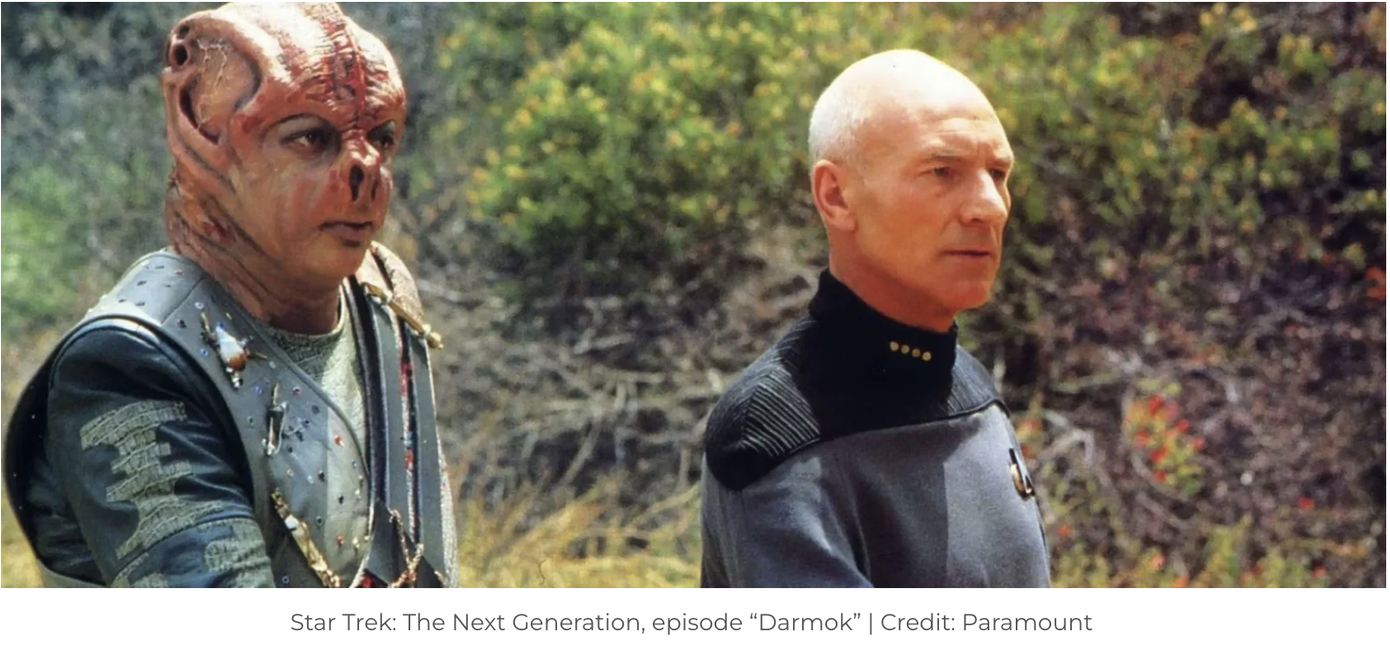
Through shared experience, storytelling, observation, and patience, Picard begins to understand their language and, more importantly, begins to build a relationship.
That feels remarkably familiar to the work of the connector. A dance writer may be helping an audience enter a world whose language, history, aesthetics, or conventions are unfamiliar to them. The responsibility is not to flatten that world into something immediately recognizable or comfortable, but to build a bridge into it.
First contact is about creating relationships rather than simply delivering information. The dance writer can become a bridge between the work and the wider public, helping expand who gets to encounter, understand, and participate in dance.
But first contact also carries responsibility. We are entering someone else’s world. Before deciding what to say about it, we should consider what assumptions we are bringing with us and whether we have taken the time to understand the world we have encountered.
Picard’s experience with the Tamarians reminds us that communication is not simply a matter of finding the right words; sometimes we have to learn a new language or recognize that the language we already have is insufficient.
The Researcher
Starfleet does not explore simply to collect pretty pictures. They investigate. They ask questions. They gather information. Dance writers can do the same in the role of the researcher.
Writing contributes to the ecosystem when it investigates not only what is happening onstage, but why it matters, where it comes from, and how it connects to larger conversations in the field. This might mean researching an artist’s lineage, examining a choreographic practice, documenting an emerging movement, or investigating the structures that shape who gets to make and experience dance.
A particularly useful example is “The Chase,” an episode of Star Trek: The Next Generation in which Picard’s archaeological interests become central to the crew’s investigation. The Enterprise crew discovers evidence that seemingly unrelated humanoid species across the galaxy share a common origin. What begins as a mystery becomes an investigation involving archaeological artifacts, genetic information, historical records, and multiple cultures.
The crew does not simply observe what is in front of them; they follow clues backward in time to understand how the present came to be.
That is part of what research can do for dance writing.
A performance rarely exists in isolation. There are lineages behind techniques, communities behind forms, teachers behind artists, economic structures behind institutions, and histories behind aesthetic choices. Research allows a writer to move beyond I saw this toward I understand more about how this came to be.
Research also requires humility. We cannot know everything about every community, history, or artistic practice we encounter. Sometimes the most responsible thing a writer can do is recognize what they do not know and seek out people who can help fill those gaps.
The researcher, like a Starfleet science officer, should approach the unknown not as an empty space waiting to be filled with their own assumptions, but as something worthy of investigation.
The Witness
Perhaps one of the most important—and complicated—roles is that of the witness.
Dance is ephemeral. A performance happens, the lights go down, and the moment is gone. Writing creates another kind of life for it: a record, a conversation, a piece of knowledge that can exist beyond the performance itself.
“Who Watches the Watchers?” from Star Trek: The Next Generation offers an especially entangled example of this idea.
The Enterprise crew discovers a group of Mintakans whose society has unknowingly been exposed to Federation technology. When the crew attempts to correct the situation, their intervention is interpreted through the Mintakans’ existing cultural framework, and Picard becomes an object of religious belief.
The episode raises a question that feels particularly relevant to the dance writer: What happens when the observer becomes part of the story?
We may enter a theater believing that we are simply watching. But our presence, our perspective, and eventually our writing all become part of the ecosystem we are observing. We are not invisible cameras.
This requires more than description. It asks writers to notice patterns, shifts, absences, and emerging voices. It asks us to consider whose stories are being told, whose histories are being remembered, and who is being left outside the frame.
It also requires us to acknowledge our own position as observers. We do not enter a theater, studio, rehearsal, or community as neutral beings. What we notice—and what we fail to notice—is shaped by who we are and what we bring with us.
Critical writing does not have to mean adversarial writing. To witness critically is to take the work seriously enough to look closely.
The witness is not passive. To witness is to pay attention, and to acknowledge that paying attention carries its own responsibility.
The Archivist
Dance has a notoriously fragile relationship with its own history. Artists disappear from the record. Performances are forgotten. Communities and contributions become marginalized or inadequately documented.
Dance writers can help recover these stories.
Writing can bring overlooked artists and histories back into conversation, document performances that might otherwise leave little trace, and preserve the experiences of a field that is constantly changing. In this sense, the dance writer becomes an archivist—not simply recording what is happening now, but helping determine what future generations will be able to find.
For me, perhaps the most powerful Star Trek example of this role is the Star Trek: Voyager episode “Living Witness.”
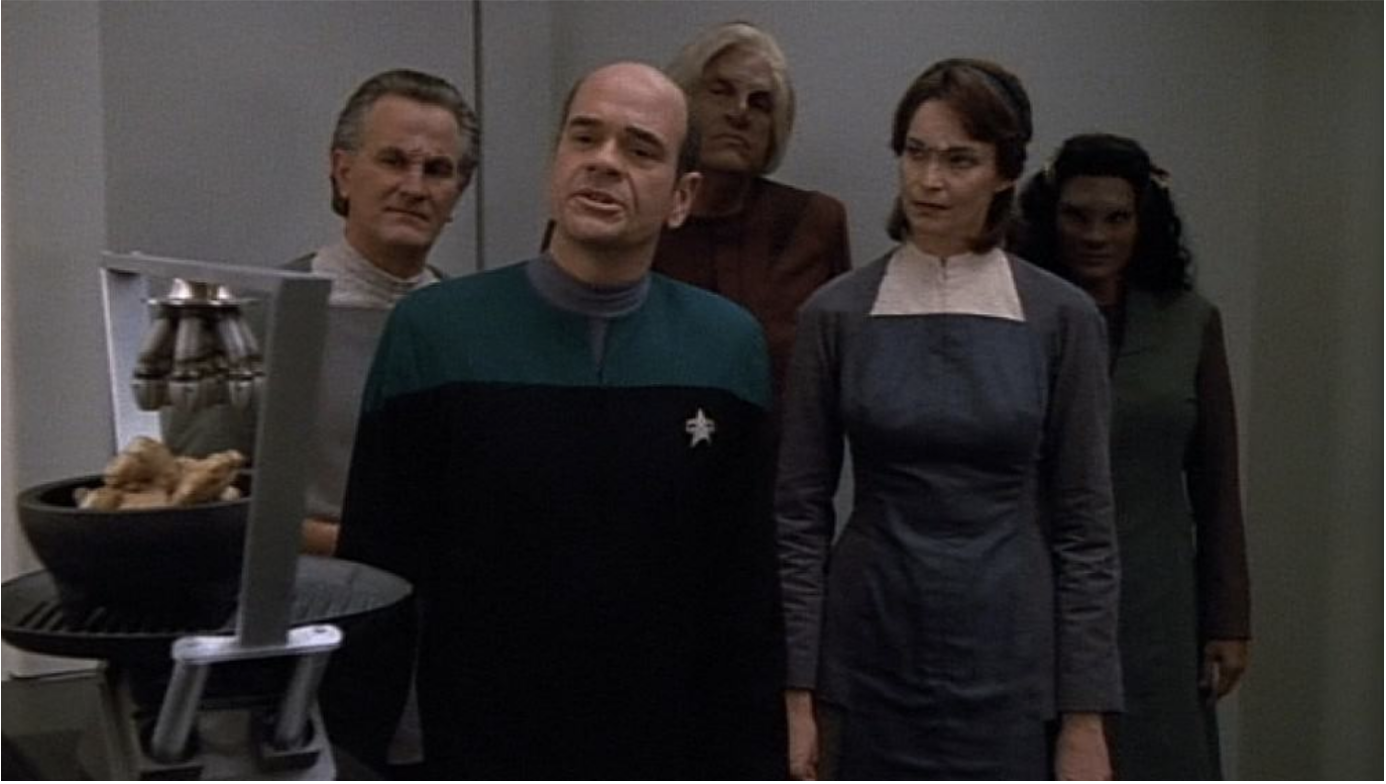
Seven hundred years after the Voyager crew has passed through a region of space, a backup version of the Doctor is reactivated in a museum. He discovers that the museum’s historical record depicts Captain Janeway and the Voyager crew as violent oppressors, blaming them for a devastating conflict between two alien civilizations.
The Doctor becomes a witness to the gap between what actually happened and what history remembers.
He works to correct the record, but the episode also makes clear how difficult that task can be. Historical narratives are shaped by who records them, who preserves them, who has access to them, and whose version of events becomes authoritative.
For dance writers, this is an especially important consideration.
Every review, interview, essay, photograph, and piece of criticism becomes part of the field’s informal archive. Years from now, someone may encounter an artist, company, performance, or movement solely through the words we leave behind.
That means the archivist’s responsibility is not simply to document what is most visible; it is to ask who and what might otherwise disappear.
Archiving is also an act of selection. What we choose to document becomes part of the historical record, while what we overlook may become harder to find. Sometimes the work of the archivist means seeking out stories that have not yet been given a platform.
“Living Witness” reminds us that an archive is not automatically the truth simply because it is an archive. Records can be incomplete. Memories can be distorted. Narratives can be shaped by power.
The work of the archivist, then, is not simply to preserve. It is also to question, to contextualize, and to unearth the record.
The Prime Directive
These four roles—connector, researcher, witness, and archivist—are not separate jobs; they overlap constantly. A single article might require all four.
And all four bring us back to the Prime Directive.
The dance writer is not simply standing outside the dance ecosystem, reporting back from the edge. We are participants in it. Our words can connect, investigate, contextualize, and preserve. They can also influence how artists, communities, histories, and movements are understood.
The Prime Directive does not ask Starfleet to stop exploring. It asks them to recognize the power that comes with exploration.
Perhaps that is the most useful lesson for dance writing.
We do not need to avoid criticism, disagreement, or difficult questions. Critical inquiry is essential to the work. Instead, we can approach the writing with curiosity, rigor, humility, and care.
We can research before assuming.
We can listen before speaking.
We can seek out perspectives beyond our own.
We can recognize when we are entering a world that is not ours to define.
We can remain curious about what we do not yet understand.
To write about dance is to enter someone else’s world—and then leave something behind.
So perhaps the dance writer’s Prime Directive is simply this:
Explore boldly. Observe carefully. Question deeply. And remember that the worlds we enter are not ours to conquer—they are ours to encounter, understand, and leave richer for having witnessed.
The debate between Captain Picard and Admiral Dougherty over the Ba’ku offers a useful lens for thinking about the responsibilities of dance writers. Their disagreement reveals that the Prime Directive is not always as simple as “do no harm” or “do not interfere.” Sometimes, remaining an observer can have consequences of its own, while intervention can cause harm even when it is well-intentioned. Dance writers face similar questions when entering the communities and ecosystems they document: When should we observe, when should we speak, and when does our presence or interpretation begin to shape the very thing we are trying to understand? The scene reminds us that ethical writing requires us to consider not only what we intend to do, but also the power and consequences of our actions.
Star Trek: Insurrection, 1998