
MAY|JUNE
PACIFIC NORTHWEST BALLET :DIRECTOR’S CHOICE: HOW PNB’S SEASON CLOSER REFLECTS THE EVOLUTION OF AMERICAN BALLET
Digital Performance recorded Friday, May 30 at 7:30 PM
By Theresa Ruth Howard
Disclaimer: Theresa Ruth Howard has worked closely with Pacific Northwest Ballet (PNB) for the past 10 years, supporting their efforts around Inclusion, Diversity, Equity, Anti-Racism, and Access (IDEA). While this critique/commentary reviews the company’s programming, Howard offers analysis that may, at times, draw from an intimate knowledge of the organization. This is not to express bias but to provide context and depth to the commentary.
“Newton’s Third Law of Motion states: Every action has an equal and opposite reaction.”
COVID took a great deal. Yet in the fight to survive, the inherent adaptability of the human species emerged. We adopted new practices: social distancing, masking, and working remotely over Zoom. When lockdowns lifted, dancers and choreographers returned—masked and bubbled—into studios both in person and virtually. Still unable to welcome live audiences, performances were staged in empty theaters, filmed, and presented digitally.
Pacific Northwest Ballet is one of the companies that maintained this practice, offering a digital subscription to all its programming. Not only has this created a new revenue stream, but it has also expanded access to one of America’s most exciting ballet companies.
PNB’s 2025 Director’s Choice season closer is a program that physically embodies the company’s deep commitment to confronting and addressing core issues that have historically threatened the relevance—and even the survival—of classical ballet. These include elitism, toxic workplace culture, abuse, lack of diversity, and problematic racial, cultural, or misogynistic themes embedded in the canon.
To regard this as simply “good programming” would be reductive. What’s more telling is how these programming choices came to be. The curation of this program—and the dancers who bring it to life—is the direct byproduct of a decade-long process of intentional, interrogative evolution. Over this time, PNB has leaned into the generational questions that have shaken classical forms to their core, starting with:
What are we for? Who are we for? Whom do we serve?
Since rolling up their sleeves and digging in, PNB has become a reflection of their city, their country, and, in many ways, the world. With humility—stepping down from the pedestal—and by truly listening, they have garnered trust, or at least the benefit of the doubt, within their community. And that community has begun to embrace them. Their audiences are now more colorful and intergenerational. During Nutcracker, when Act II divertissements feature corps dancers in soloist roles, crowds select tickets as if it were Wimbledon and support dancers as if it were a sporting event—complete with fan favorites that go beyond the principals.
Over the past decade, PNB has become a destination company—and school—not just because of its artistic excellence, but because it has truly transformed. It now reflects the racial and cultural multiplicity of America and has fostered an organizational culture that centers humanity. That centering is the bedrock of its inclusivity.
What makes PNB a new standard-bearer in ballet’s ongoing evolution is its unwavering commitment to IDEA—a transformation driven by Artistic Director Peter Boal and Executive Director Ellen Walker. Their leadership is a case study in the adage: Change starts at the top.
Consistency is part of PNB’s secret sauce. Ellen Walker—who feels like the heart and conscience of the work—often says, “We are going to fail, but we will fail forward.”
In 2015, when soloist Kiyon Ross retired, his departure left the company without a single Black dancer. That same year, the organization joined the City of Seattle’s “Turning Commitment into Action” program, which offered equity training for arts and cultural institutions. Two years later, in 2017, PNB joined 19 other major ballet companies in The Equity Project, an initiative to increase the presence of Black dancers in ballet, of which I was a designer and facilitator.
In 2016, Amanda Morgan and Dammiel Cruz were hired—both are now soloists—and Boal’s active recruitment efforts, coupled with holistic, organization-wide training, grew the number of Black-identifying dancers to 10. Meanwhile, Ross remained at PNB, teaching in the PNB School’s DanceChance program, coordinating the Next Step initiative, and steadily rising through the administrative ranks. He is also one of the choreographers featured on this program—and happens to be African American.
In 2019, Ross became Director of Company Operations, and in 2022, he was appointed Associate Artistic Director. Today, the company is 53% BIPOC.
But it’s about more than racial representation. PNB has become a case study in the effective sublimation of the principles and practices of IDEA (Inclusion, Diversity, Equity, and Access) to support generational shifts in the field—including around gender identity. The emergence and embrace of two nonbinary dancers, Ashton Edwards and Zsilas Michael Hughes, has gone beyond obligatory pronoun use or casting across gender roles. PNB has thoughtfully stretched itself to re-script the gendered language of ballet (e.g., replacing “ladies” and “men” with “pointe” and “flat” dancers), and to address gendered power dynamics by, for example, listing dancers alphabetically in programs rather than defaulting to “ladies first.” Even in The Nutcracker, the Cavalier has been granted autonomy—no longer simply existing to possess or orbit Sugarplum as “her” Cavalier.
There is a symbiosis between Boal and Walker that leads with humanity, humility, courage, and an indefatigable dedication to grappling with the complexities of interrogating the very structures that define the identity of an artform built on irreproachable hierarchy—structures that have historically upheld the lack of diversity, gender bias, and a toxic culture where a person’s ability to endure, and perform in toxicity is considered measure of worthiness.
With the addition of Ross, the leadership triad has gained depth and divergent perspectives. PNB has actively worked to flatten the hierarchy of communication, creating space for more voices to rise and be heard, and cultivating a culture of feedback and psychological safety in administrative and artistic space spaces—an essential condition for artists. Informal leadership is encouraged and nurtured.
It is not perfect, but like ballet itself, PNB understands that it takes training, practice, and correction to build mastery and develop muscle memory. The people of the organization are actively and continuously building an institutional identity that reflects their values—and fosters a shared sense of responsibility, accountability, ownership, and pride in every employee.
This, along with dynamic dancing, is why PNB has become a destination company.
If it seems like this prologue is ambling or extraneous to a traditional critique—ordinarily, it would be. However, context matters. The curation of dancers, choreographers, and programming does not happen in a vacuum. There are many ways one can choose to “view” a performance. One can focus strictly on what’s presented on stage: the works, the dancers’ execution, production elements, etc. A strict adherence to those aspects is a valid approach.
That said, in 2025, such a narrow lens feels incomplete—especially when the world is in a state of existential crisis. When art functions as a reflection, a response, documentation, or the ignition of ideas, it feels appropriate—even necessary—for its scribes to evolve to meet the moment and its expanding demands.
The aforementioned context is not fluff; it is presented to illustrate that this—and all programming—is the tangible and visible byproduct of accumulated choices.
Watching the Director’s Choice program feels like PNB’s dissertation—a presentation of the work the organization has committed itself to over the past decade. Work that has shaped it into a quintessential expression of:
-
Ballet as a classical artform
-
America as a multiracial, multicultural nation; and
-
The emergence of what we now recognize as “American ballet”: born of the same lineage but raised elsewhere—wild, incorrigible, and rule-breaking—the younger sibling of divorce to her elder sister, who was brought up in the gilded courts of Europe and Russia.
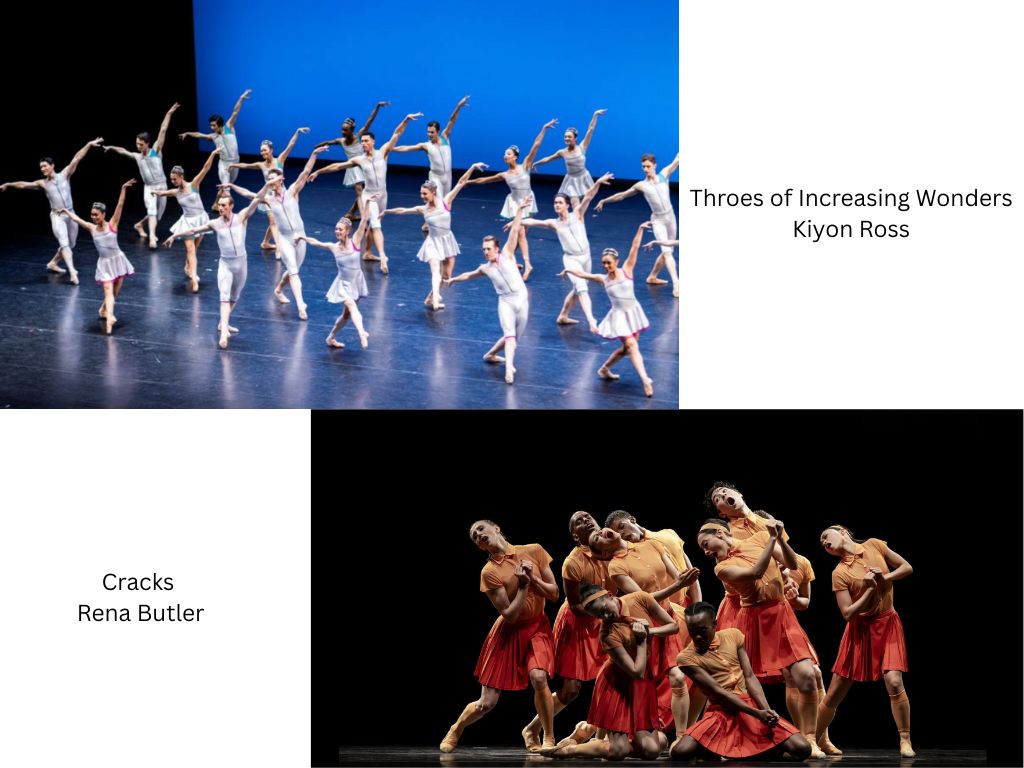
This double bill featured two choreographers from opposite ends of the dance spectrum. Associate Artistic Director Kiyon Ross opened the program with his Throes of Increasing Wonder. Ross, a PNB alum trained at the School of American Ballet, represents ballet’s classical lineage. His work was followed by Cracks from contemporary choreographer Rena Butler, whose performance credits include Hubbard Street Dance Chicago, AIM by Kyle Abraham, the Bill T. Jones/Arnie Zane Company, and David Dorfman Dance.
The pairing of these two highly divergent works is a vivid illustration of PNB’s versatility—its ability to swing the pendulum from Ross’s high-octane neoclassicism to Butler’s protean, often earthy contemporary vernacular. The dancers moved seamlessly from the floor to pointe like unfettered mercury. While it has become standard for classically trained dancers to shift fluidly across styles, this company feels less like a collection of individuals and more like a living organism—one fueled by… joy.
I hesitate to write that because it sounds speculative. Of course, performers can perform joy. Dancers can be physically moving in unison and still not be dancing with one another. When they catch eyes, it might be choreography, character work, or something organic—but there is a difference, and it’s palpable. Dancers use a secret, nonverbal language—articulated through breath, grunts, whispers, smiles, flashes of eyebrows and eyes—that communicates everything from delight in a section or step, exaserbation, mistakes or missed cue, offer support, or even an S.O.S.
If you’ve been a performer, you can discern the difference. As an audience member you know the signs.
This is where viewing the performance on film has an advantage: camera angles allow for closer observation of the dancers’ faces, where authentic smiles and eye contact can be seen. In both works, regardless of genre, the joy with which this company is dancing with one another is unmistakable.
As an opener, Ross’s Throes of Increasing Wonder gives us authentic delight and real joy. I say that with confidence because the piece is too technically demanding—and too relentless in stamina—to fake it.
Throes of Increasing Wonder premiered in 2023, created in celebration of PNB’s 50th anniversary. Originally, the large white cube that opens the piece—dismantled into moveable panels during the work—was wrapped in a red bow, signaling that this was Ross’s gift to the company. And what emerged from that box was a gift: a cast of 24 bursting forth with exuberance so electric it’s contagious.
Much of Throes moves with lightning speed, evoking the feeling of one of those tricky-dicky petite allegro combinations that dancers, although exhausted, can’t get enough of and want to repeat again and again—refusing to let it get the best of them—until the teacher finally waves a hand: “Enough, okay, okay,” and everyone breathlessly laughs.
With a cast of 24—10 corps de ballet members and 12 lead couples—Throes is also a gift to the dancers themselves. It showcases the company’s depth of talent from tip to tail, apprentice to principal. (It’s important to note that although PNB is a ranked company, casting seldom aligns strictly to rank.) It feels like Ross choreographed a ballet he would have loved to dance himself.
Though grounded in the Balanchine aesthetic, Ross doesn’t replicate it—he sublimates it. He tests its boundaries with speed and athleticism, intricately crocheting steps together. His eloquence and respect for the purity of ballet technique prevent his choreography from veering into the contemporary. Instead, staying true to the tradition of Balanchine, Ross modernizes without bastardizing—adding just enough seasoning to affect the flavor: a body roll, a flick of the head, a twist of the hip.
Ross is a ballet choreographer who capitalizes on the multi-genred physical intelligence of this generation of PNB dancers. He gives them space to tap into the freedom of interpretation and expression cultivated in contemporary practice, while trusting them to understand and uphold classical principles—particularly those of the corps de ballet: unison, clarity, precision.
The traditional aesthetic of the corps de ballet—developed and still largely maintained in Europe and Russia—relies on physical uniformity (in height, shape, facility), reinforced by technique and style. This uniformity erases individuality, absorbing the many into a single body to emphasize symmetry, choreographic patterning, and sculptural tableaux. It also makes it difficult to distinguish one dancer from another.
Although Balanchine rewrote the rules. He redrew the line, redefined the function of the corps, while still upholding a preferred physical ideal.
Boal’s (and now Ross’s) PNB features a company that spans a broad spectrum of body types in height, structure, build, and facility. Their uniformity is grounded not in physical sameness, but in shared dynamics and approach—reminiscent of Arthur Mitchell’s Dance Theatre of Harlem in the 1980s.
Over the past decade, Boal and Walker have made tremendous strides in the “D” of diversity—but it’s their efforts around the “I” of inclusion that have fortified that work and set them apart. Diversity and inclusion both exist on a spectrum—one that spans identity itself. The result has been the cultivation of a ballet culture (and truly, an organizational culture) that recognizes and honors the humanity and individuality of its artists.
Ross’s work reflects that recognition. His principal couples are cast with an eye toward chemistry, musicality, and contrast—each with a distinct temperament and tone:
-
Mark Cuddihee and Clara Ruf Maldonado (a standout in both works) are vibrant and flirtatious.
-
Madison Rayn Abeo and Noah Martzall are clean and crisp.
-
Christopher D’Ariano and Sarah-Gabrielle Ryan bring cool refinement.
-
Jonathan Batista and Angelica Generosa are playfully elegant.
Among the demi-soloist couples:
-
-
Ashton Edwards and Kuu Sakuragi sparkle like firecrackers, throwing sparks with their footwork.
-
Zsilas Michael Hughes and Juliet Prine are well-matched in both performance quality and technical ability.
-
The dancers’ secret language—is on full display, as is the company’s remarkable depth of the talent especially in it’s corps has made it norm for dancers to be cast above their rank.
Ross makes excellent use of this embarrassment of riches, especially in how he challenges the corps de ballet, led by the dynamic (and I do mean dynamic) duo of Roslyn Hutsell and Destiny Wimpye. They command the stage with every entrance, serving Black girl ballet magic. As is said in AAVE: they ATE. And judging from their infectious smiles they knew it!
The shimmering, opalescent costumes—designed by Pauline Smith with flashes of turquoise, fuchsia, and lavender—make the dancers appear like facets of a diamond. Priceless
Throes is a breathless whirlwind of a ballet, keeping pace with Cristina Spinei’s driving score. It’s beautifully structured, with smartly crafted moments of counterpoint, and it hurtles forward until, finally, the sky explodes in a burst of confetti—raining joy down on dancers and audience alike.
Rena Butler’s Cracks, her inaugural work for PNB, strips away artifice, wings are flown out, light rigging exposed, shadow replaces glitter. Programatically we are on the flip side—in the Stranger Things “Upside Down”—of the beauty and light embodied in Ross’s work. The cast of ten pointe and flat dancers, dressed identically in burnt-orange, pleated, knee-length skirts and apricot, button-up collared shirts with matching knee socks, stands in parallel lines, hands clasped in front of them. They begin by reciting Michel Wackenheim’s Celui qui fera paraître le Christ au temps fixé—“He who will make Christ appear at the appointed time.” When they begin to move, it is with the stifled breath of anxiety or fear (Dochi’s “Anxiety”)—a battle between piety and… something unnamed. Perhaps that blank is meant to be filled in by the performers themselves, using the rich, expressive movement and gestural vocabulary Butler has constructed.
She achieves what few contemporary choreographers working with ballet companies manage: locating the natural borders between gestural movement and the ballet idiom—and using both in measured balance. Rather than relying on the extrapolated torque that has become the hallmark of many contemporary ballet voices (think Forsythe, King, Rhoden), Butler walks the boundaries of divergent techniques. Within her amalgam, each element is rendered distinctly, the “brackishness” between forms shallow, as all are given full value—without hierarchy.
Here Butler draws on gestural clarity, torso articulation, isolations, and the punctuation of limbs—tools often associated with postmodern and downtown dance—to craft a patois that is lush, expressive, and entirely her own. The result is a rich movement language that constructs a world unto itself—like a ship. In the case of Cracks, it may well be a cathedral.
The work is sophisticated—conceptually rigorous, aesthetically cohesive, understated in appearance yet rich in emotional and physical texture. Clearly borne of process, it demands trust, buy-in, and deep commitment. Without that, its gestures would be hollow, its steps reduced to mere steps.
Characterization is embedded in the movement and embodied by the dancers, each of whom appears to be fighting an internal battle that is breaking something within. The struggle is to hold the pieces of themselves together.
In dance, the journey to performance is often palpable in the performance itself. And here, the individuality previously mentioned makes each dancer distinguishable, even when dressed alike and moving in unison. Their interpretations are singular—beautifully singular.
We silently bear witness to a cohort in the throes of spiritual struggle—grappling with godliness, conformity, and internal rupture. The soundscape includes sacred and modern compositions: Gabriel Fauré’s Madrigal, Antonio Vivaldi’s Laudate Dominum, Ljova’s Less, Francis Poulenc’s Salve Regina, Claude Debussy’s Quant j’ai ouy le tabourin, and Michael Praetorius’s Audite, silete—all punctuated intermittently by the ominous sound of cracking, breaking, and crumbling.
The muting of gender is not only achieved through costuming, but through casting. Zsilas Michael Hughes dances en pointe, paired with Elle Macy in a duet that demands technical precision and feline agility. Together they roll down from pointe to all fours, arching their backs, shifting their weight to one arm, then battementing a leg before recovering to standing through a piked handstand into a développé. Butler’s choreography requires dancers to be equally proficient on pointe, on the floor, and in the transitions between the two—strength and fluidity in equal measure.
There are striking, haunting moments. In the final section, the dancers form a line downstage, hunched low and stomping forward like linebackers—confronting something invisible but formidable. The formation dissolves into a tormented solo by Macy. At one point, she executes an astonishingly slow back walkover into a split, dragging her hand beneath her as though trying to reach beneath the stage. She passes through second position, extends to the other side, then lies on her back, piking, bicycling her legs upward before stabbing the floor with her pointe shoes, rocking over them to her knees.
The dancers reassemble into their starting tableau. But then Luca Anaya breaks away, his solo almost a plea—part surrender, part declaration—as the ensemble expands into isolated spaces. Each ends in what feels like a personal purgatory.
Perhaps it’s the work I do in cultural reform and IDEA—particularly with PNB—that shapes my personal lens, one through which the appellation “Director’s Choice” feels apropos on a cellular level. If you know what to look for, you’ll see that it truly is just that—the choices made are what made this inspiring and exciting evening of dance, and these dancers, possible.
At a time when so much of the progress we’ve fought for feels at risk of being undone, it gives me hope.
PNB is proof that the work is working.